AMC Exam
AMC clinical exam format: what the day is made of
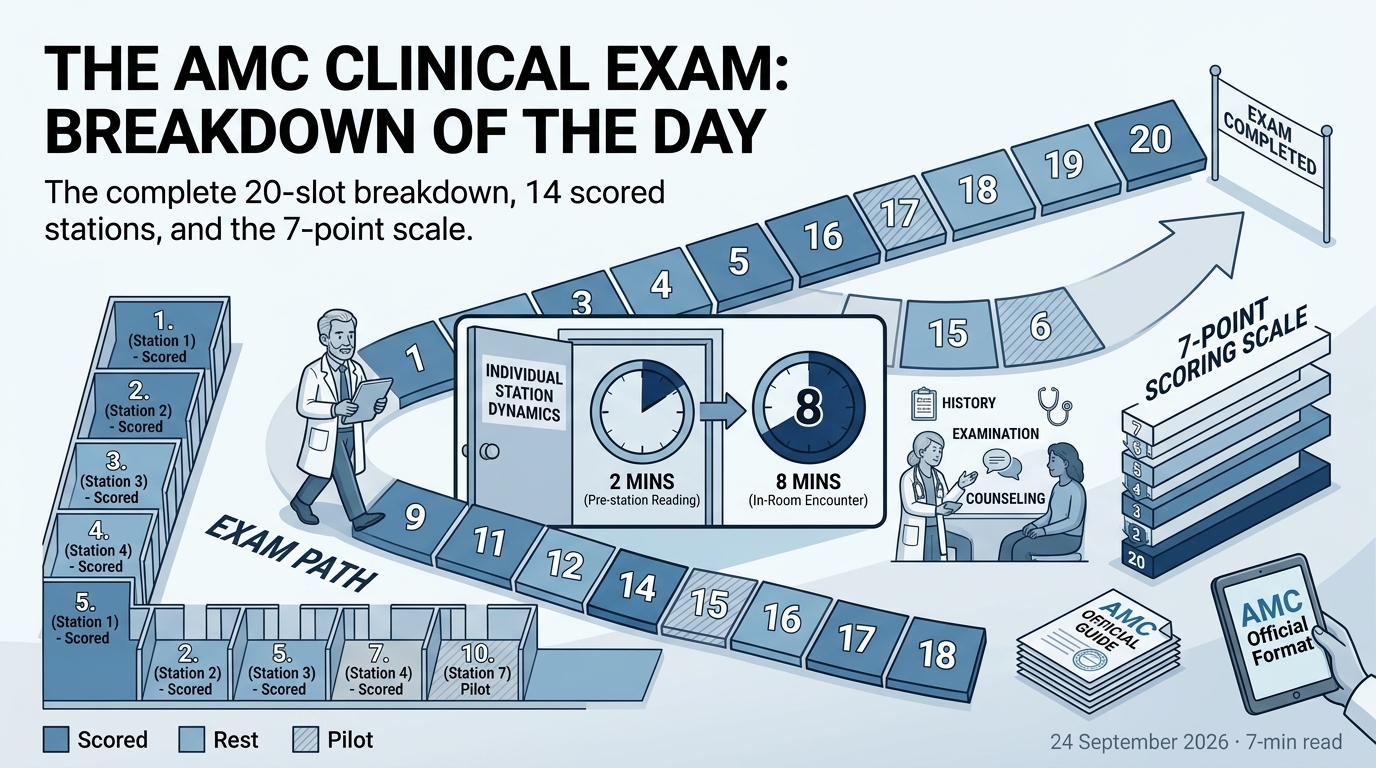
The AMC clinical exam format in one place: 20 slots, 14 that count, 2 minutes at the door and 8 in the room.
7 min read

7 min read
The AMC publishes the station counts but not the choreography. What twenty slots, four rests and a changeover minute add up to on the day.
Everybody preparing for the AMC clinical exam knows a station is 8 minutes. Ask the same person how long the exam is and the answer goes vague — a morning, most of a morning, however long 16 stations take.
That vagueness is the thing worth fixing, because the day has a shape and almost none of it happens inside them. There is time before the first door, time between every pair of doors, and four sit-down stretches in the middle that are not breaks in any sense you would recognise. Candidates rehearse the stations and then meet the choreography for the first time on the day it counts.
Start with what is actually documented. The AMC’s clinical examination page and its Clinical Examination Specifications are the only two sources worth quoting on this, and between them they give you the counts and the per-station clock and then stop.
What the AMC does not publish is the choreography: what time you are told to arrive, how long the briefing runs, or where in the circuit the rest stations fall. Those things exist, and they will be in the instructions the AMC sends you for your own sitting. They are not on the website, which means anybody quoting you a start time or a rest station position off a blog — this one included — is telling you about their sitting rather than yours. Read your candidate instructions and believe those.
What follows, then, is the arithmetic rather than the timetable. The arithmetic is enough to change how you prepare.
The number in most people’s heads is 16, because that is the number of doors with a patient behind them. The circuit is 20 slots long. The 4 rest stations are stations: they have a position, they take their turn, and you sit them whether you feel you need to or not.
Of the 16 that count for something, 2 are pilots — material being trialled before it is used in earnest — and they do not contribute to your result. You cannot pick them out. That is deliberate, and it is the only sensible way to run it: a candidate who knew which two were free would spend them differently. The practical consequence is that there is no station you can afford to coast, and the marking that decides each one is the same whether it counts or not.
So the honest count of things you have to walk into and perform in is 16, and the honest count of times the bell moves you somewhere is 20.
Between the end of one station and the reading time for the next there is roughly a minute of walking. It is the least rehearsed minute in the exam and the only one that is entirely yours — no card, no patient, no examiner writing anything down.
Most candidates spend it on the wrong station. They spend it on the one that just ended: the question they meant to ask, the examination they rushed, the thing the patient said at minute seven that they did not follow up. This is the single most expensive habit available on the day, because the cost is not paid in the station where the mistake happened. It is paid in the next one, which you walk into already half-occupied.
The minute has one job, and the job is to finish the last station so it stops following you. Whatever ritual does that for you — naming the case once and letting it go, a breath at the door, deliberately reading the number on the next door — is worth building before the day, because a minute is not long enough to invent one in.
A rest station is around 10 minutes in a chair, and there are 4 of them. On paper this is the easiest part of the morning. In practice it is where a good number of candidates quietly lose the second half of the exam.
The failure mode is treating it as study time. Ten minutes is long enough to feel like an opportunity and far too short to be one. What people do with it is re-run the last three stations, or try to recall a guideline they are now worried about, and they stand up at the bell more tired and more rattled than they sat down. Nothing was learnt. Ten minutes of recovery was spent on anxiety.
The alternative is boring and it works: treat the rest station as the only part of the morning with no performance in it. Sit back. Drink something. Let your attention go somewhere with no clinical content in it at all. You are not going to acquire knowledge in the next ten minutes, and you are definitely going to need attention in the next thirty.
Because the AMC does not publish where the rests fall, the circuit here lays them out the way a circuit sensibly would: the longest unbroken run of stations first, while you are fresh, and no rest tacked on the end where it would only delay being told you may go home. That comes out as runs of 4, 3, 3, 3, 3 stations with a rest between them — ours rather than the AMC’s, and useful mainly because it puts the hardest stretch where it belongs.
End to end, that is about 216 minutes of circuit, before anything that happens at check-in. Three and a half hours, near enough, of continuous assessed attention with no compensation between stations and no point at which you get to stop being marked.
Which is an argument about length rather than content. The longest block of this circuit is 4 stations back to back — around 44 minutes without a chair — and a practice session that stops short of that never reaches the part of the morning where consultations start to change shape. What that change looks like, and what to do about it, is the half of preparation that does not happen at a desk. This post is only here to tell you how long the stretch is.
All of which is easier to read than to do, because the length is the part you cannot simulate with a study partner for an afternoon. A single station will tell you about your pacing. A full circuit is the only thing that tells you about your morning.
We are not affiliated with the AMC. The counts and the per-station timings above are from the AMC’s own pages; the block layout and the total are this app’s. Where this post and the specification disagree, the specification is right.
AMC Exam
The AMC clinical exam format in one place: 20 slots, 14 that count, 2 minutes at the door and 8 in the room.
7 min read

AMC Exam
Seven things that go wrong inside an AMC clinical station, why each one costs the global rating, and what to do differently.
6 min read
AMC Exam
What the AMC clinical exam is once you have passed AMC 1: the 16-station format, how it is marked, booking, results and what the certificate unlocks.
6 min read