For IMGs sitting the AMC clinical exam

Most practice stops at one station. The exam doesn't.

ClinicalVitals runs full AMC stations with a voice patient who answers in character, on the exam's own clock, and marks the transcript domain by domain. Then it runs 14 of them back to back, so you find out what your consultations sound like three hours in.

One full station free. Spoken patient, exam bells, full scorecard, and the top-mark walkthrough afterwards. No credit card.
Stations acrossMedicineSurgeryPaediatricsPsychiatryWomen's HealthGeneral Practice
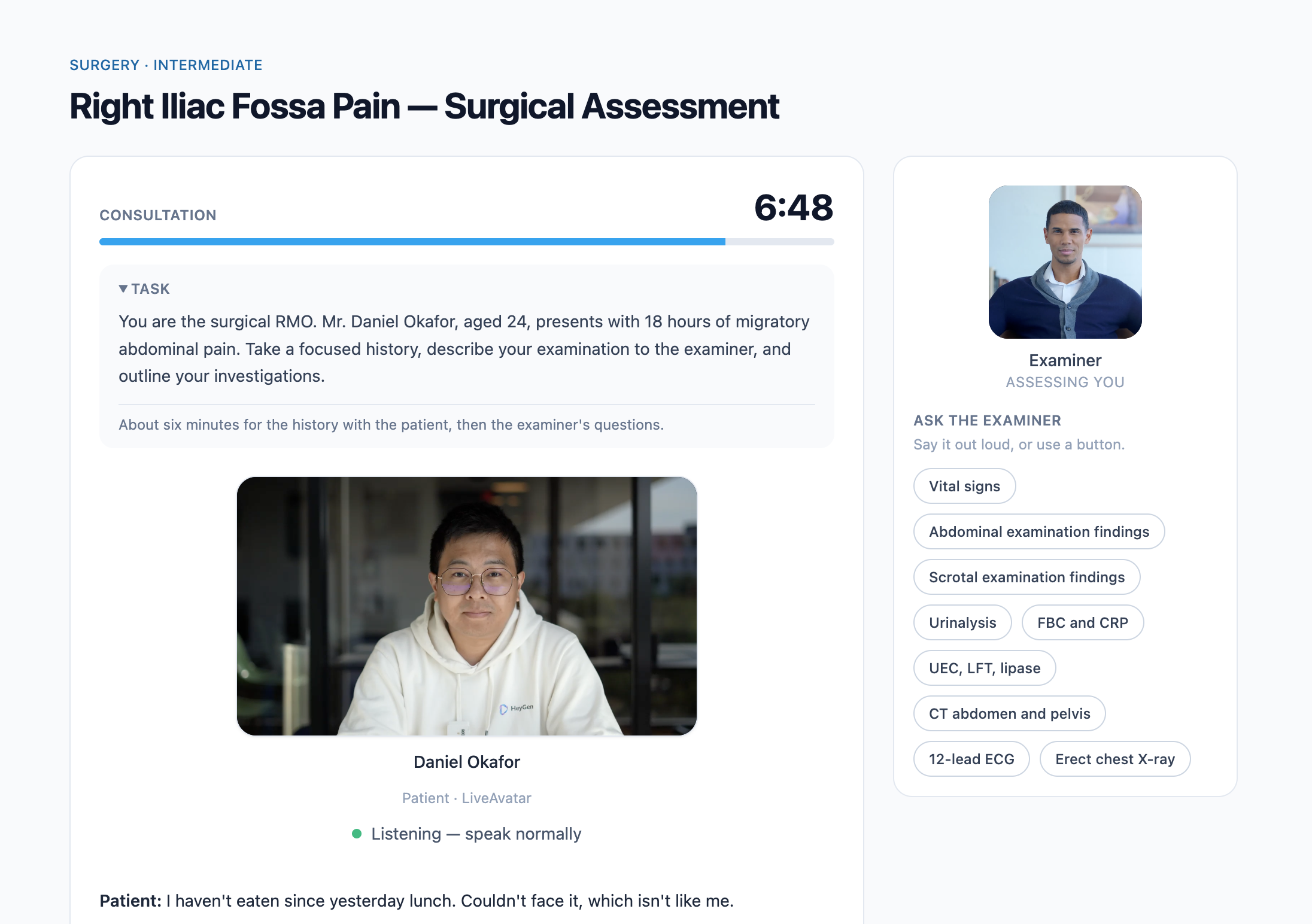
A station in progress: a surgical assessment stem with a 6:48 countdown, the voice patient on camera, and the examiner panel offering examination findings and investigations.
A station mid-consultation: the clock, the stem, the patient, and an examiner you can ask for findings.

The marking

What comes back when the time is up

Example scorecardAcute Chest Pain, Emergency Department
3 / 7global ratingNot a pass
Approach to the Patient
5 / 7Opened well and checked what the patient already understood.
History Taking
4 / 7Pain characterised thoroughly. Family history never explored.
Management Plan
2 / 7Reached for anticoagulation before excluding a dissection.

3 of 13 domains shown

Key misses

  • Did not ask whether the pain tore through to the back.
  • No safety-netting before the patient was sent home.

Critical. Failed to screen for aortic dissection before reaching for anticoagulation.

Scored against the domains the AMC actually marks: 1 to 7 across all 13. Misses are named rather than summarised, and anything that could have harmed the patient is carried on its own line instead of being folded into the prose. Stations are marked to eTG, the RACGP Red Book and Australian consent standards.

Sitting a station also unlocks it performed at the top of every domain, spoken by a model candidate alongside the patient and examiner you just had. It appears under your result, so it never gives away a station you have yet to attempt.

The mock circuit

The whole exam, in one sitting

Anything can hold a conversation for eight minutes. The exam is three and a half hours long, and the consultation that decides it is rarely the first one.

The 14-station circuit

Plus two unscored stations you will not be able to pick out, and four ten-minute rest stations.

A pass is 9 of the 14 scored stations.

No marks until it is over, and no way to skip a rest station, because the position in the circuit is read off the clock rather than advanced by a button. The report at the end reads your rapport and counselling scores over the first four marked stations against the last four, so a performance that falls away under fatigue arrives as a number instead of a feeling.

Circuits run on a pass, and spend sixteen stations of your fair-use allowance in an afternoon. The free station is a single station.

How a station runs

Built to the exam's own rules

The patient talks back, and interrupts

Full-duplex audio, so you can cut in and redirect the way you would in the room rather than waiting out a paragraph. Each station keeps the same patient voice every time you sit it.

The clock is the exam's, not yours

Two minutes reading, then eight minutes consulting, with a chime at one minute left. The countdown runs against a real deadline, so switching tabs buys you nothing.

An examiner is in the room

Ask for examination findings or investigations and the examiner answers aloud, then puts questions to you in the closing minutes, one at a time.

Your accent carries no marks

Marking assumes a transcription error before a candidate error. Grammar and accent score nothing either way, and what is assessed is the clinical reasoning underneath them.

Questions

Before you start

Is this affiliated with the AMC?
No. ClinicalVitals is independent educational software, not affiliated with or endorsed by the Australian Medical Council, the General Medical Council, or any other examining body. We name those exams only to say which ones this helps you practise for. Read the full disclaimer.
Is the free station really free?
Yes — one full station, no credit card. You need an account because a station is ten minutes of live voice audio that costs real money to run. Nothing about it is cut down: same patient, same bells, same scorecard and transcript.
What does it cost, and does it renew?
$200 AUD for 3 months, or $70 AUD for 14 days. Each is a single payment — nothing renews, nothing charges you again, and there is nothing to cancel. Passes stack rather than overwrite: buy a sprint while a longer pass is still live and its 14 days start when that one ends. See pricing.
What does “unlimited” actually mean?
Unlimited within a fair-use limit of 20 stations in any rolling 24 hours, one at a time. That is well past what anyone sits in a day of preparation — it exists so a single login cannot be shared around or scripted. Stated here rather than left for you to discover by hitting it.
Can a real person mark my station?
Yes, as an optional add-on: $49 AUD for one station. You ask for it from your scorecard once you have sat that station, and a reviewer reads your whole transcript and marks it again against the same rubric, with written feedback on what to change. It usually arrives within 5 days. It is a one-off charge for that station, separate from any pass, and it adds nothing to your access — everything else here is marked by the AI examiner, instantly and at no extra cost.
Can I get a refund?
Yes. If the service is not what you expected, ask within 20 days of purchase and we will refund the pass. Use the contact button in the corner of any page.
What if my connection drops mid-station?
A station you have started stays resumable for 15 minutes, so a reload or a browser crash does not cost you the sitting. After that it frees up automatically and costs you nothing against your fair-use count.

Hear the patient before you decide anything.

One full station, free, with nothing cut out of it. Read your own scorecard and judge whether the marking is fair. Then $200 AUD opens the whole catalogue and the mock circuit for 3 months.