AMC Exam
AMC clinical exam format and timing: the whole day explained
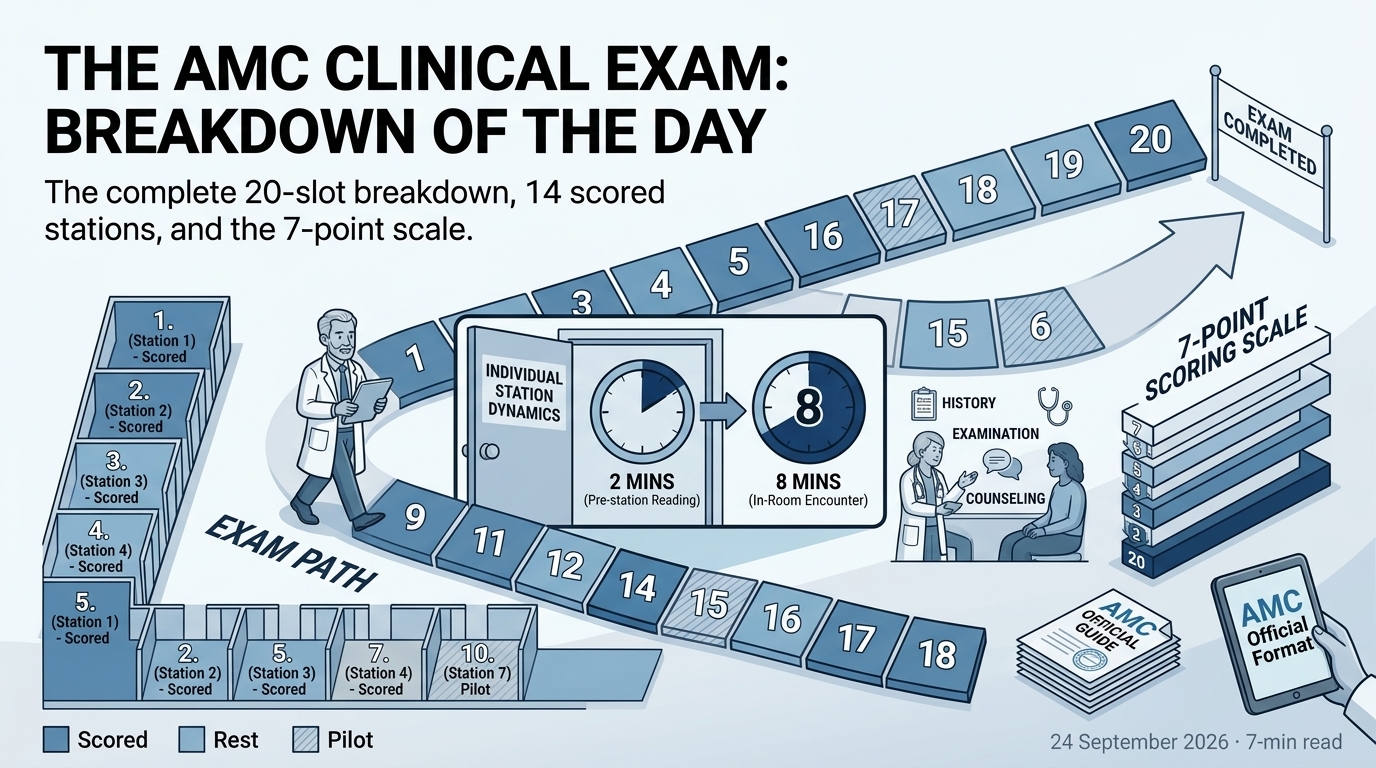
The AMC clinical exam format and timing in one place: 20 slots, 14 that count, 2 minutes at the door, 8 in the room, and how the morning runs.
10 min read
Exam-standard drill · no account needed
5 cases written for AMC Clinical Examination candidates. Read the card, choose the 3 questions you could not leave the room without asking, and find out what an examiner would have made of it.
Mr John Reid, 52, has had central chest pain since six o'clock this morning. He smokes, was told years ago that his blood pressure was high and never followed it up, and has come in reluctantly because he does not want to miss a shift.
Try the case first. Each one has 3 questions a AMC Clinical Examination examiner expects you to ask before the patient leaves.
Mr John Reid, 52, has had central chest pain since six o'clock this morning. He smokes, was told years ago that his blood pressure was high and never followed it up, and has come in reluctantly because he does not want to miss a shift.
“Does the pain go anywhere else — into your jaw, your neck or either arm?”
Radiation to the jaw, neck or arm is one of the features that moves this from indigestion to an acute coronary syndrome. You must ask about it directly rather than waiting to see whether he mentions it.
“Did the pain hit you all at once at its very worst, and does it go through to your back?”
Instantaneous, maximal pain tearing through to the back is the screen for aortic dissection. Miss it and the anticoagulation you would reach for in a heart attack becomes the thing that kills him.
“Are you more short of breath than usual, and have you had any pain or swelling in a calf?”
This is the pulmonary embolism screen, and it is the one candidates drop when they have already decided the pain is cardiac. Ask it before you commit to a diagnosis.
Ms Amelia Novak, 28, has been feeling low for about three months. She has stopped seeing friends, is sleeping badly, and says she is just tired all the time.
“Have you had any thoughts of harming yourself, or that life is not worth living?”
You must ask about suicidal thinking directly, in plain words, in every low-mood consultation. Asking does not plant the idea, and not asking is the single most reliable way to fail this station.
“Have you made any plan, or done anything to act on those thoughts?”
Thoughts, plan, intent and means are separate questions and you have to ask all of them. Someone who has chosen a method and a time needs a different disposition today than someone who has passing thoughts.
“Have you ever tried to harm yourself before, and is there anything at home you have thought about using?”
A previous attempt is the strongest single predictor that there will be another, and access to a method is what turns intent into an act. Both are things you can act on the same day — tablets can be held by someone else tonight.
Sarah Lang has brought her 18-month-old daughter Ivy, who has had a fever for two days. Ivy has been off her food and is clingier than usual, and her mother says she is not herself.
“Has she had a rash anywhere — and if you press a glass against it, does it fade?”
A rash that does not fade under pressure is meningococcal disease until proven otherwise. You have to ask, and you have to look — parents often will not volunteer a few spots.
“How many wet nappies has she had in the last day?”
Urine output is one of the most reliable things a parent can tell you about how dehydrated a toddler is. Dropping wet nappies is the objective measure that turns a well-looking child into an admission.
“Has she been floppy, or hard to wake at any point?”
Altered conscious state is the red flag that outranks every number on the chart. A child who is difficult to rouse needs to be seen now, whatever the temperature is doing.
Mr Daniel Okafor, 34, has had low back pain for a week since lifting at work. It is worse today, and the pain now runs down the back of both legs.
“Have you noticed any numbness around your back passage, or between your legs when you wipe?”
Saddle numbness with bilateral leg pain is cauda equina syndrome until excluded. Ask it explicitly and in words he will understand — no one offers this symptom unprompted.
“Any trouble passing urine, or have you leaked without realising?”
Bladder dysfunction is the finding that turns back pain into a same-day surgical decompression. Retention with overflow is easy to miss unless you ask about both.
“Has there been any weakness in your legs — trouble lifting your feet, or getting up stairs?”
Progressive motor weakness alongside bilateral pain completes the picture. Weakness that is getting worse by the day is the part that decides how fast he is scanned.
Mrs Priya Raman, 31, is 30 weeks into her first pregnancy and noticed fresh vaginal bleeding this morning. The pregnancy has been straightforward until today.
“Has there been any pain with the bleeding, and does your tummy feel tight or hard?”
Painful bleeding with a tense uterus is placental abruption, and the blood you can see may be a fraction of what has been lost. Painless bleeding points elsewhere — you cannot manage this until you have asked.
“How much blood has there been — spotting, or soaking through pads — and have you felt dizzy or light-headed?”
What you can see on a pad understates what has been lost, and a fit 31-year-old compensates until she suddenly does not. Volume and light-headedness together are the first sign that the mother, not just the baby, is in trouble.
“Have you felt the baby move today, and as much as usual?”
There are two patients here and only one of them can tell you anything. Reduced movements alongside bleeding is the sign that the baby is already compromised.
From the blog
Practical advice and real-world insight from someone who has sat the exam.
AMC Exam
The AMC clinical exam format and timing in one place: 20 slots, 14 that count, 2 minutes at the door, 8 in the room, and how the morning runs.
10 min read

AMC Exam
Seven things that go wrong inside an AMC clinical station, why each one costs the global rating, and what to do differently.
6 min read
AMC Exam
What happens once you pass AMC 1: booking the clinical exam, sitting it in Melbourne or online, results, the AMC certificate and the road to registration.
4 min read