
AMC Exam
The AMC clinical exam mistakes that actually fail stations
Seven things that go wrong inside an AMC clinical station, why each one costs the global rating, and what to do differently.
6 min read
7 min read
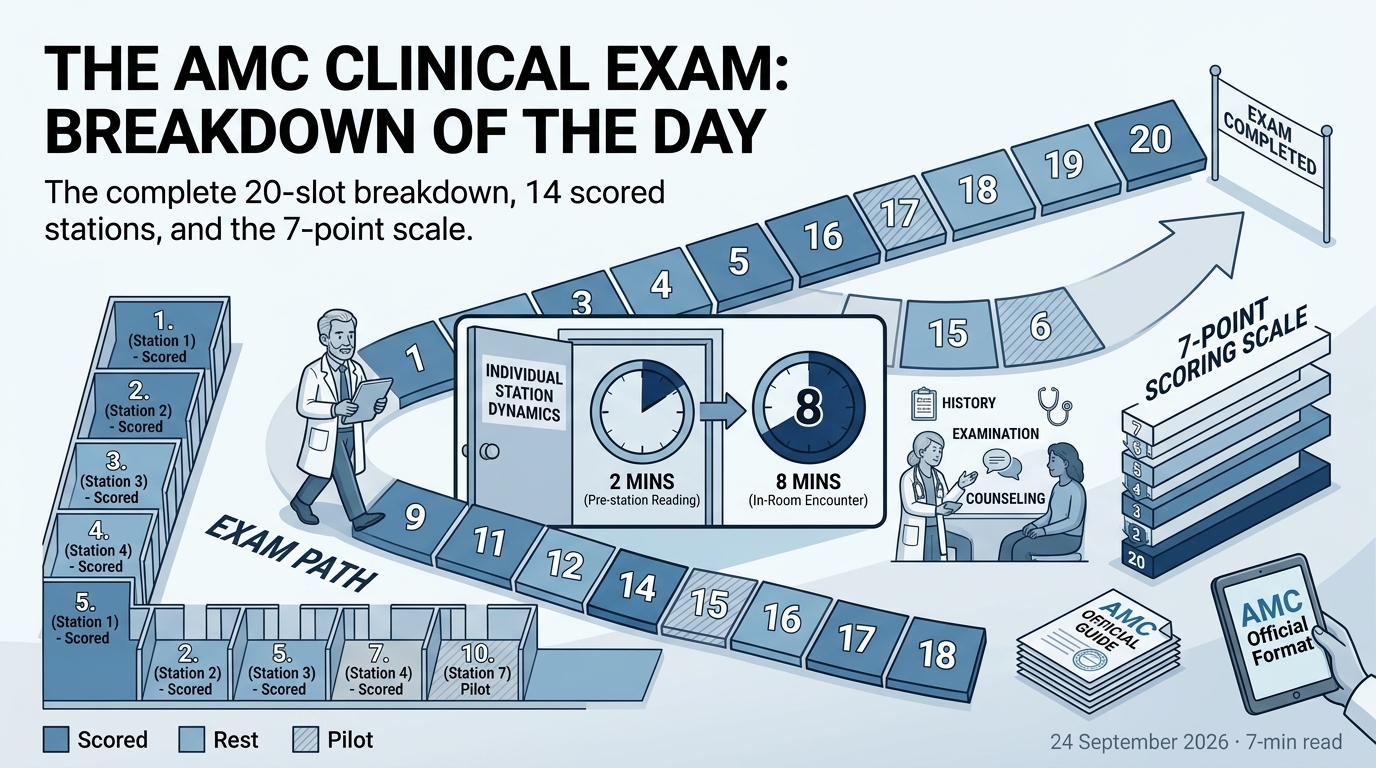
The AMC clinical exam format in one place: 20 slots, 14 that count, 2 minutes at the door and 8 in the room.
Almost everything about the AMC clinical exam format is published, and almost nobody reads it in one sitting. A station count comes off the AMC site, a marking scale off a course handout, a pass mark off a forum thread that was right two years ago, and the picture assembled out of those three is usually correct in the parts that do not matter.
So here is the format in one place. 20 slots, 14 of them scored, 2 minutes outside each door and 8 minutes inside it, and a 7-point scale that decides each station on a single number.
None of it is complicated. It is spread out, and the places people come unstuck are the ones where the published number and what it implies about the day are not the same sentence.
You sit 16 stations. Among them sit 4 rest slots, which brings the circuit to 20 slots end to end. A rest is a station you sit out — same length, same bell, nobody behind the door — and it is timetabled rather than offered, so where yours fall is not something you get a say in.
Everyone moves at once. The circuit is a corridor of numbered doors and you work your way around it, one door at a time, in an order set before you arrived. There is no skipping a station you would rather come back to, and no station runs long because the last one ran short.
How those slots are laid out across a morning — where the rests fall, what the walk between doors is for, where the tiredness lands — is a longer story than the format. The shape above is the part the AMC publishes.
Of the 16 stations you sit, 14 are scored and 2 are pilots. The AMC trials new material this way. A pilot is run like any other station and marked by the examiner in the room in the ordinary way; the marks simply never reach your result, and are not reported back to you either.
You are not told which two. They are not shorter, not stranger, not obviously experimental, and not parked at the end where you might expect an afterthought to go. A pilot is a station that felt exactly like a station.
Every station runs the same clock. 2 minutes outside with the stem card, 8 minutes inside with whoever is on the other side of the door, and 60 seconds to get to the next one. That is 11 minutes a slot, and the bell is indifferent to where you got to in it.
The card on the door is the entire brief. Who the patient is, where you are meeting them, and the tasks, numbered. Read the tasks twice. The second read is where people notice the one they were about to quietly leave out.
2 minutes is enough to plan and not enough to improvise, which is the point of it. What it should buy you is an opening sentence, an order to take the tasks in, and a decision about where the halfway mark sits. Walk in without those and you build them out loud, in the room, out of the 8 minutes.
Stations are built around tasks, and the tasks are the contract. One that asks you to take a focused history, give your most likely diagnosis and explain what happens next is asking for three things, and is marked as three things. Two of them done beautifully is still two of three.
The disciplines are not announced in advance and the mix is not yours to choose. Medicine, surgery, paediatrics, obstetrics and gynaecology, and psychiatry are all in scope, and the format is what makes breadth matter more than depth: you will sit more stations in a morning than you have areas you feel confident in.
The AMC rubric runs to 13 assessment domains, from approach to the patient and history taking through to management plan and patient counselling. No station uses all of them. A typical one is marked on three to five, picked by what the station is actually for — a counselling station is not marked on accuracy of examination.
Each domain in play is rated on a 7-point scale, on which 4 is the borderline pass: the standard of a junior doctor safe to practise under supervision. Alongside the domains the examiner records key steps — the handful of actions, usually between two and five, that this station considers essential.
9 of the 14 scored stations, and nothing sits on top of that count. No aggregate, no compensation: an outstanding station and a bare pass are both one station passed, and a run of brilliant ones will not rescue 6 failures.
Read the other way round, the bar allows 5 failed stations, which is more room than most candidates think they are given. That is worth knowing on the day, because the expensive thing about a bad station is almost never the station. It is the two after it.
The format is the one part of this exam you can rehearse exactly, because it is the part that does not change. A single station runs the clock the AMC runs. A full circuit runs all 16 of them, rests included, which is the only way to find out what you are like at the far end of one.
What the format leads to — booking, results, the certificate and what it unlocks — is a separate walkthrough.
We are not affiliated with the AMC. The station counts, the timings and the marking scale above are from the AMC’s own pages; how this app arranges a circuit around them is ours. Where this post and the specification disagree, the specification is right.
AMC Exam
Seven things that go wrong inside an AMC clinical station, why each one costs the global rating, and what to do differently.
6 min read

Exam Day
The AMC publishes the station counts but not the choreography. What twenty slots, four rests and a changeover minute add up to on the day.
7 min read
AMC Exam
What the AMC clinical exam is once you have passed AMC 1: the 16-station format, how it is marked, booking, results and what the certificate unlocks.
6 min read