AMC Exam
AMC clinical exam format: what the day is made of
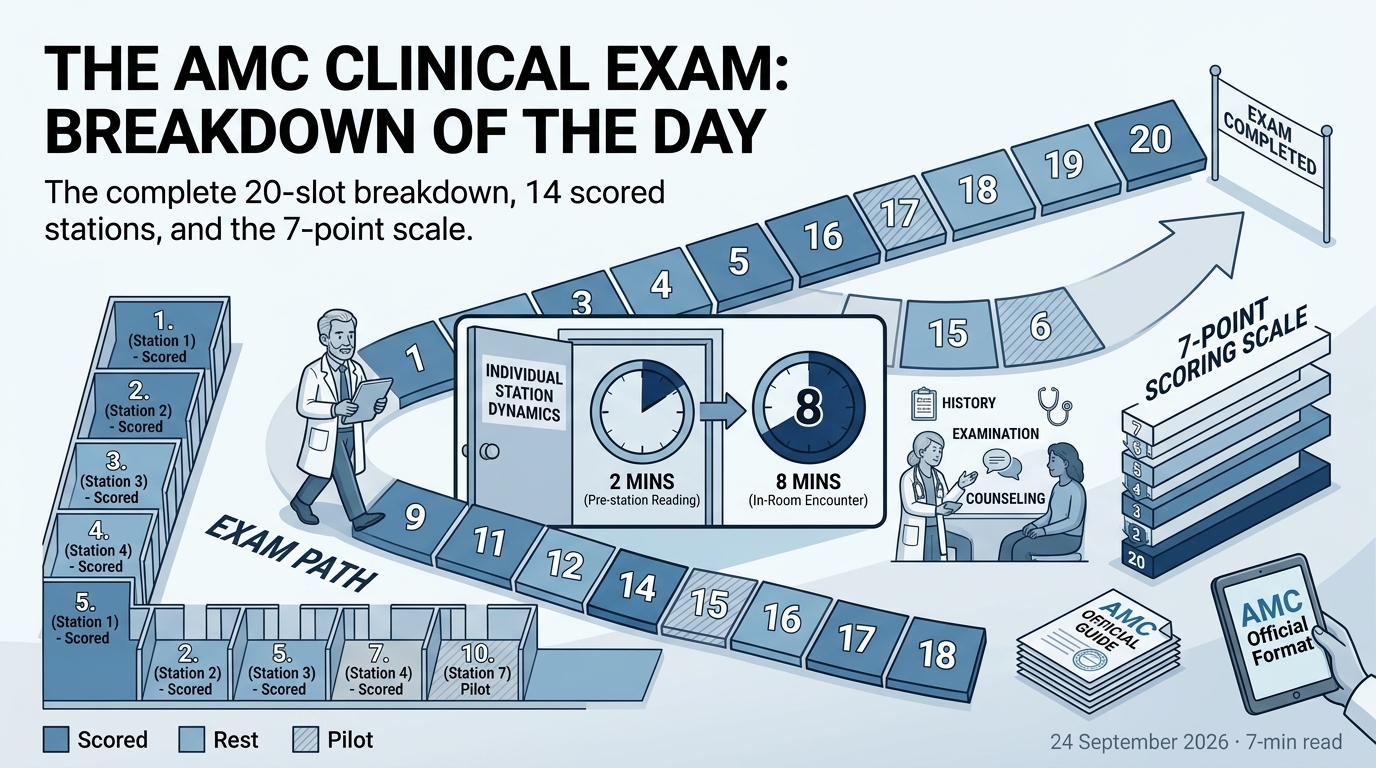
The AMC clinical exam format in one place: 20 slots, 14 that count, 2 minutes at the door and 8 in the room.
7 min read

6 min read
Seven things that go wrong inside an AMC clinical station, why each one costs the global rating, and what to do differently.
Nobody fails the AMC clinical exam for not knowing what coeliac disease is. Knowledge was tested a year earlier, in a building with no patients in it. What fails stations is smaller and far more repetitive than that, and after enough consultations you stop being surprised by which things it is.
Seven of them, in rough order of how often they turn up. Every one of these is a station that felt fine while it was happening — that is the whole problem with them — and the global rating that decides the station is awarded by somebody who can only mark what was in the room.
A differential you narrowed silently, a red flag you ruled out somewhere between two questions, a plan you had settled on by minute four and never announced: none of it happened, as far as the mark sheet is concerned. A global rating of 4 or better on the 7-point scale is a judgement about a performance, not about the candidate behind it.
This is the most expensive habit on the list and the cheapest to fix, because it costs a sentence. Say what you think it is. Say what else it could be. Say what you have ruled out and what made you rule it out. Candidates who do this are not smarter than the ones who do not — they are just audible.
The commonest shape of a failed station is a good history that ran to minute six. You have 8 minutes and the card in front of you listed more than one task, so a history that fills the station is not thoroughness. It is the whole station spent on the first thing asked.
Management is where most stations are won, and it is always last, which makes it always the part the clock takes. Being thorough earlier does not protect you here. It is the thing causing the damage.
Safety questions get dropped when the case does not seem to call for them, which is precisely the case the station was built out of. The headache that is obviously tension. The back pain in somebody far too young. The low mood where nobody asked the question about self-harm because the conversation was going well and the question would have spoiled it.
The failure is almost never that you did not know the red flags. It is that you did not ask, in a station where asking was the point. Drilling which screens each presentation demands is worth more, this close to the day, than another chapter of anything.
The tasks on the card are the mark sheet, printed and handed to you before the station starts. Candidates still drop the last one, or answer them in whatever order the consultation drifts into, and arrive at time being called with a task untouched.
Usually it is the third or fourth task, which is usually the explaining or the counselling, which is usually the one the station exists to examine. The history was never the interesting part to the person marking it.
A consultation can be accurate, complete, on time and still mark badly, because approach to the patient is its own domain and it is not a politeness score. Nobody asked what they were worried about. Nobody checked what they already understood. The plan was delivered in one long paragraph, in the register of a discharge summary, and then the candidate asked whether there were any questions in a tone that made clear there was no time for one.
A plan the patient could not repeat back to you was not communicated, whatever was said. This is the domain where the fix is most visible from outside: shorter sentences, one idea at a time, and a genuine pause after each.
An examiner who stops you mid-examination and moves you on is keeping the circuit to time. The AMC’s Clinical Examination Specifications say so, and say not to read anything into it. Candidates read a great deal into it anyway.
That is the real cost. The interruption was free; the four rattled minutes after it were not, and neither were the next two stations spent replaying it. Nothing carries over between stations — each is marked on its own, and a pass is 9 of 14 — but candidates carry it over anyway, which is the one way a single bad station can actually cost you three.
The 2 minutes with the card are not a warm-up. They are the only part of the station where you can plan without it costing you anything, and most people spend them being nervous at a piece of paper.
Read the tasks. Count them. Decide the order and the rough minutes, and pick the two or three things it would be unsafe to leave out. Walk in without that and you will build the plan out loud instead, in the room, on the clock — and that time comes off the end, which is where the management was.
None of these is a knowledge fix, and that is why they survive so much revision. You sit 16 stations in a morning with no compensation between them, so a habit you have not noticed does not cost you one station. It costs you the same station, repeatedly, all morning.
AMC Exam
The AMC clinical exam format in one place: 20 slots, 14 that count, 2 minutes at the door and 8 in the room.
7 min read

Exam Day
The AMC publishes the station counts but not the choreography. What twenty slots, four rests and a changeover minute add up to on the day.
7 min read
AMC Exam
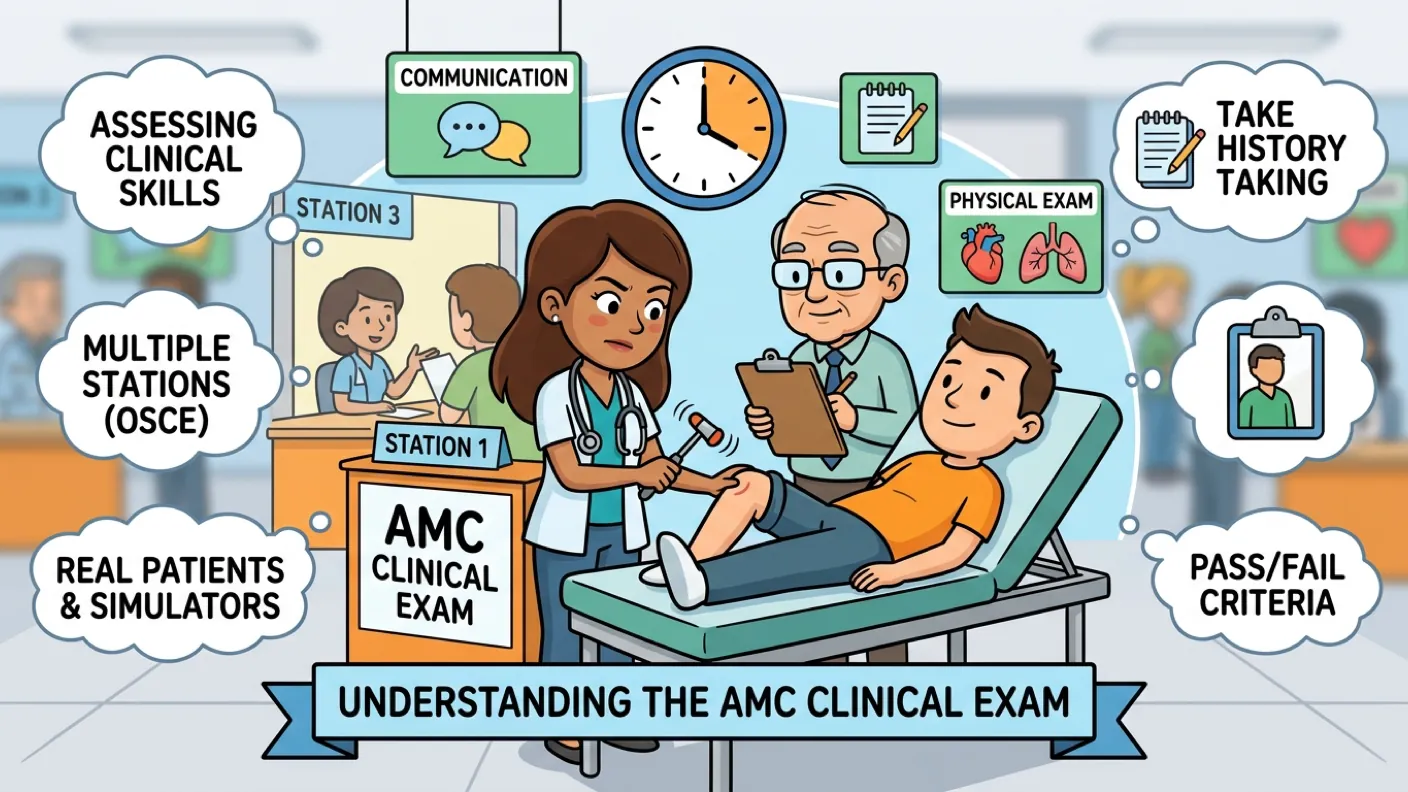
What the AMC clinical exam is once you have passed AMC 1: the 16-station format, how it is marked, booking, results and what the certificate unlocks.
6 min read