Most AMC preparation is reading. That's the wrong half
5 min read
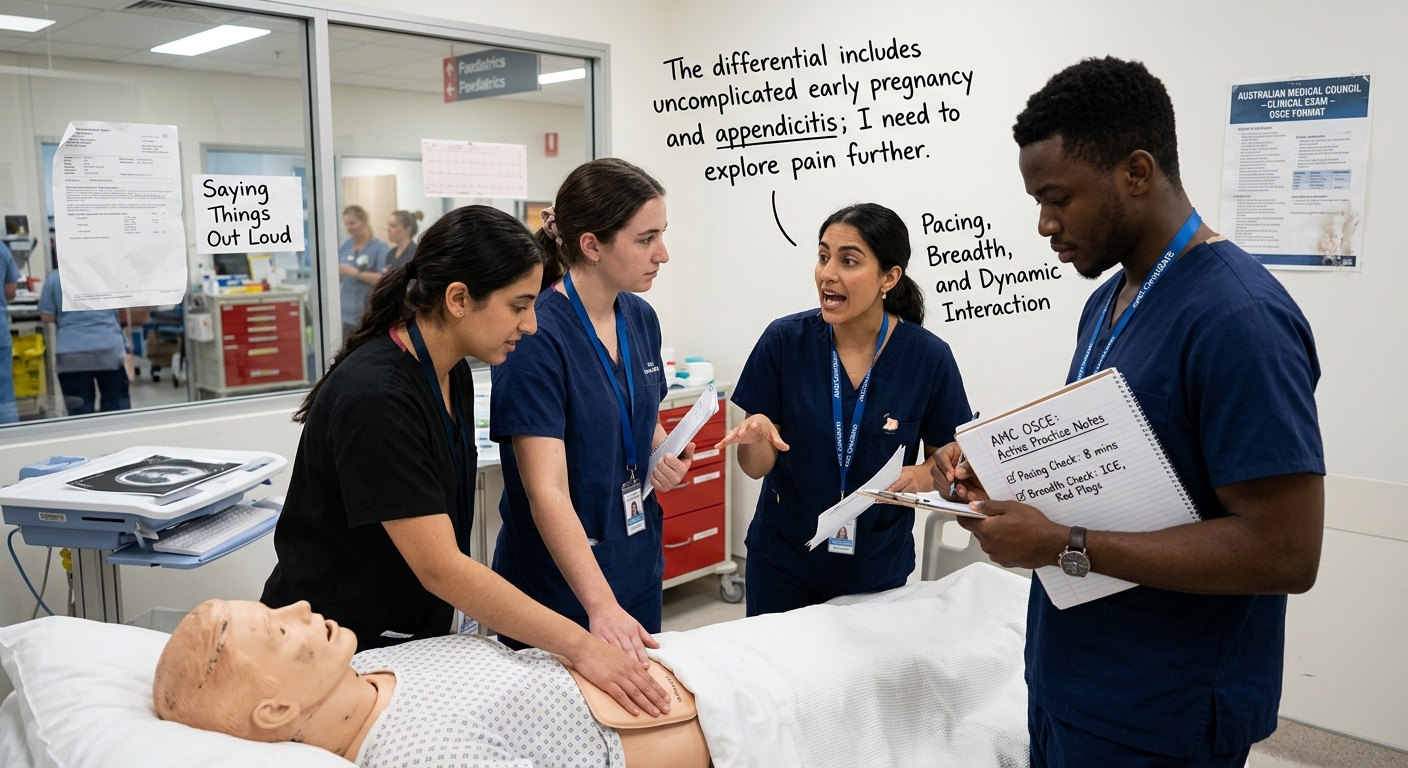
Notes on the part of AMC preparation that does not happen at a desk: pacing, breadth, and saying things out loud. Most people are busy doing the other half.
Ask someone three weeks out how their preparation is going and you will almost always hear about reading. A second pass through the handbook. Somebody’s recall bank, shared into a group chat with forty other people in it. Notes rewritten because the first set had gaps.
It is work. It is just mostly not the thing being examined.
You get 2 minutes with a card on a door and 8 minutes with the person on the other side of it. Reading gets you the content. It does very little about what happens after you open the door.
The stations you feel best about
One of the odder things people report, once they have sat a run of stations back to back, is that the ones they walked out of feeling good about were not the ones that had gone best. That is not really a paradox. Fluency and rapport are the two things you can feel while they are happening. Coverage is not something you can feel. You find out afterwards, if you find out at all.
A history that flows, that the patient is comfortable in, and that never gets to the question you were supposed to ask, is not a good consultation with a small hole in it. The hole moves. What you did not ask shapes what you concluded, which shapes what you then offered, so by the end you have built a plan on top of the gap without ever noticing it was there.
Breadth, then depth
You do not get to pick which disciplines turn up. You will sit more stations in a morning than you have areas you feel confident in, so the arithmetic is against depth before you start.
This is the correction most preparation needs and it is an unpopular one, because it means spending your time badly on purpose. The discipline you avoid is where the trouble comes from. It is also, by definition, the one you least want to give up a Sunday to. Going deeper on the thing you already like feels like preparation, and mostly is not.
- Count them. Write out the disciplines and how many stations you have actually practised in each. The gap is rarely where people expect it.
- Do the worst one first, while you are fresh. At the end of a session you will let yourself off.
- Stop scoring practice out of ten. Ask whether you would have been happy if that had been the real one.
The clock
Almost everyone practises cases. Far fewer practise them on the clock, and hardly anyone practises the 2 minutes outside the door, which is where the shape of the consultation is decided. Walk in without a plan and you will end up building one out loud, in the room, and that time comes off the end.
The failure looks like this. Thorough history. Good rapport. Time called somewhere in the middle of the examination. No diagnosis, no management, nothing said about what happens next.
Nothing went wrong in that station except the pacing, which is the annoying part, because pacing is not something you can read your way out of. You fix it by running out of time over and over, under conditions where running out of time actually costs you something, until your sense of where the halfway point sits stops being a guess.
Say it out loud
Thinking is invisible. Someone who considers the serious diagnosis, quietly rules it out and moves on has, as far as anyone else in the room is concerned, not considered it.
Signposting usually gets taught as a courtesy to the patient, and it is one. It is also the only mechanism you have for making your reasoning part of the consultation instead of something that happened silently in your head.
Three hours in
You do not sit one station. You sit 16 of them in a morning, one after another, and whatever your consultations look like near the end of that is most of the day rather than a footnote to it.
Practice almost never looks like that. It happens one case at a time, fresh, with a break whenever you want one, which tells you about your ceiling. The day is closer to a measure of your floor. People are usually surprised by the distance between the two, and there is no way to find out what yours is except to sit a long run of stations once, before it counts.
What to change
- If more than half your preparation is reading, it is the wrong half.
- Run stations to the clock, reading time included, and let the bad ones end badly. A station you stopped early taught you nothing about pacing.
- Write down what you left out, every time, and keep the notes. Ten of those tell you more than any one of them.
- Get the breadth first, and sit a long run back to back at least once before the day itself.
None of this is a secret and none of it is a shortcut. Preparation just drifts towards whatever is easiest to count, and pages are much easier to count than stations.